
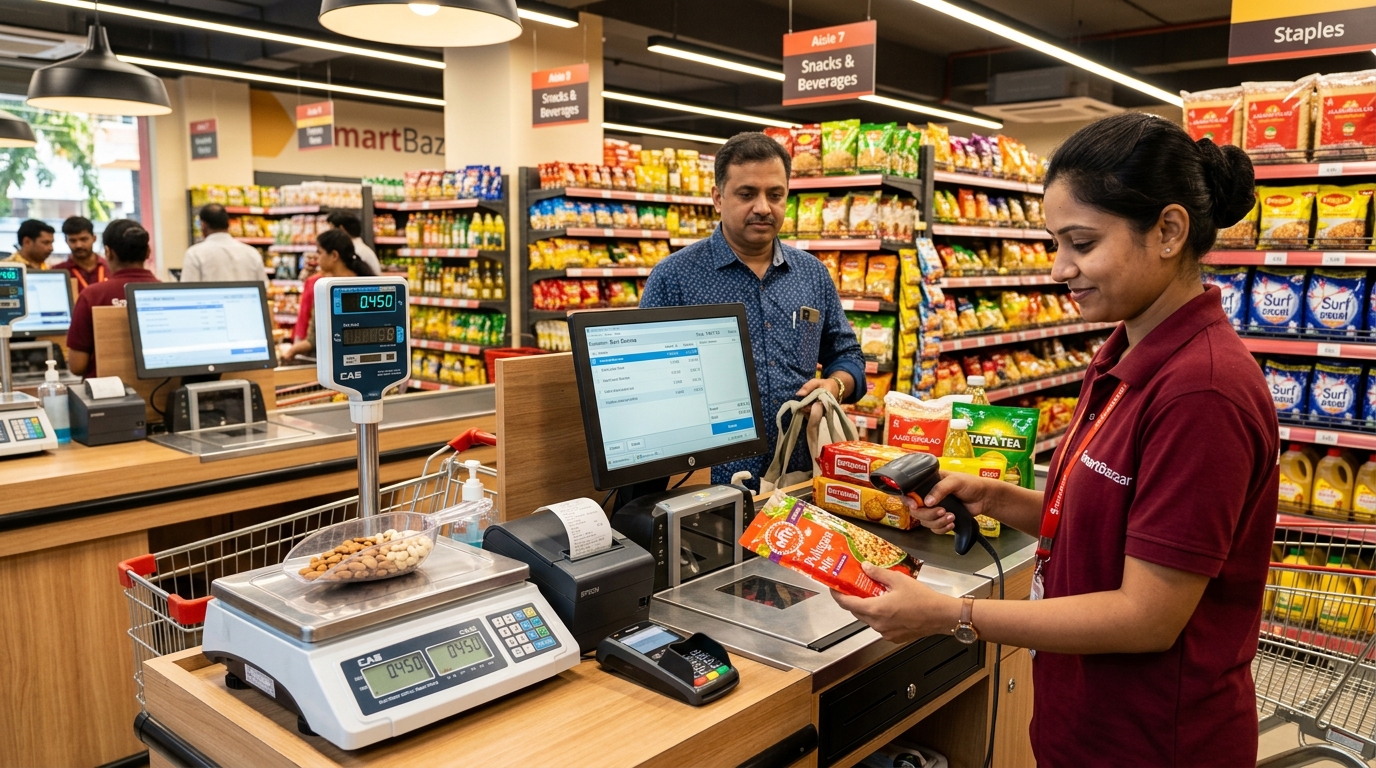
FMCG billing software is a high-speed retail point-of-sale (POS) and inventory control engine built specifically to withstand the relentless footfall and vast catalog size of fast-moving consumer goods stores, supermarkets, and modern kirana outlets in India. Unlike general business accounting software, an authentic FMCG billing platform comes pre-loaded with over 20,000+ ready Indian brand barcodes (Tata, Parle, Nestle, HUL, ITC, Amul), connects directly with electronic digital weighing scales via RS232/USB for loose pulses and grains, automates master carton-to-retail pouch breakdown, flags near-expiry batches before stock spoils on shelves, and calculates intricate manufacturer trade schemes (such as 12+1 free or volume slabs) right at the cash counter.
Tired of Long Evening Checkout Queues at Your Grocery Counter?
See how sub-second barcode scanning, instant digital weighing scale sync, and 20,000+ pre-seeded Indian FMCG products work live in a 2-minute specialist walkthrough.
Table of Contents: Navigating This Ground-Reality Guide
- 1. The High-Volume Pressure of an Indian FMCG Counter
- 2. Pre-Loaded FMCG Barcodes: Why Manual Typing is Business Suicide
- 3. Dual Units & Master Carton to Retail Pouch Breakdown
- 4. Electronic Weighing Scale Integration for Loose Staples
- 5. Near-Expiry Alerts & Vendor Breakage Claim Debit Notes
- 6. Calculating Brand Trade Schemes, BOGOs & Margin Matrices
- 7. Customer Khata Udhar Management & Dynamic UPI QR Invoices
- 8. Recommended Hardware Blueprint for Indian Supermarkets
- 9. Frequently Asked Questions (FAQ) with Expert Practical Answers
1. The High-Volume Pressure of an Indian FMCG Counter
Ask any experienced supermarket or grocery store owner about their biggest headache, and they won't say purchasing goods or arranging shelves. They will point straight at the cash counter between 6:30 PM and 9:30 PM.
During evening peak hours, an average neighbourhood departmental store handles between 80 and 250 walk-in shoppers. A customer with a wire basket containing 18 items—milk packets, bathing soap, biscuits, loose sugar, cooking oil, dishwash gel, and spices—expects their bill in under 45 seconds.
If your cash counter software requires the cashier to manually type names like "Aashirvaad Shudh Chakki Atta 5kg" or search drop-down lists with a mouse, billing grinds to a halt. Shoppers standing in long queues with crying toddlers or melted ice cream packets get irritated, abandon their shopping baskets in aisles, and walk away.
This is why Indian grocery retail demands a purpose-built FMCG and supermarket POS billing system that operates at sub-second scanning speeds. Every microsecond saved on item lookup directly protects your daily footfall and turns casual walk-in shoppers into lifelong loyal customers.
| Daily Operational Challenge | What Happens with Generic Billing Software | How an FMCG-Engineered POS Handles It |
|---|---|---|
| Evening Rush Footfall | Cashier searches items manually with keyboard; billing takes 3 to 4 minutes per customer. | Omnidirectional hands-free scanner reads EAN-13 barcode instantly; entire 15-item basket finalized in 35 seconds. |
| Loose Grains (Dal, Chawal, Sugar) | Staff weighs item on separate scale, writes weight with pencil on polybag, cashier types kilograms manually. | Scale connected to POS via serial cable; weight transfers to bill in 0.2 seconds with tare deduction. |
| Wholesale Carton vs Retail Sale | Stock balance goes negative because goods were received as 1 Carton but billed as 96 single pouches. | Automatic packaging breakdown converts master boxes into loose piece stock without balance drift. |
| Short Expiry Stock (Dairy, Biscuits) | Products expire silently on rear shelves, resulting in 100% margin loss when thrown into trash. | Batch tracker fires alerts 45 days before expiry, prompting clearance discounts or vendor debit note claims. |
2. Pre-Loaded FMCG Barcodes: Why Manual Typing is Business Suicide
A standard departmental store stocks anywhere between 3,500 and 12,000 active SKUs. A large supermarket easily crosses 25,000 SKUs.
When a shopkeeper installs traditional retail software, the vendor usually hands them an empty database and says: "Bhaiya, aap apne saare items ek-ek karke feed kar lo."
Think about what that actually means:
- Picking up a pack of Parle-G, scanning its 13-digit EAN number (e.g.
8901719101038). - Typing the exact item description: "Parle-G Glucose Biscuit 65g".
- Entering the 8-digit HSN code (
19053100). - Selecting the GST tax slab (18%).
- Typing the MRP and purchase cost.
Even if you type one item every 90 seconds, cataloging 5,000 items takes over 125 hours of mind-numbing data entry! Most shopkeepers give up halfway through, leaving half their store unbarcoded and reverting to manual counter chaos.
The Cloud Master Catalog Advantage
Modern cloud-powered FMCG billing software solves this upfront bottleneck through a centralized, pre-seeded master catalog of over 20,000+ Indian FMCG barcodes.
- Zero Setup Fatigue: The moment you scan a pack of Tata Salt, Maggi Noodles, Dettol Soap, Amul Butter, or Fortune Sunflower Oil, the system instantly recognizes the EAN barcode, autofills the verified brand name, attaches the statutory HSN code, and sets the government GST rate.
- Immediate Day-1 Go-Live: A new supermarket or renovated kirana store can unbox their barcode scanner in the morning and start billing customers that very afternoon.
3. Dual Units & Master Carton to Retail Pouch Breakdown
In Indian wholesale FMCG distribution (whether from distributors of ITC, Britannia, or local agencies in regional mandis), goods are strictly supplied in Master Cartons, Cases, or Crates.
For example:
- Maggi 2-Minute Noodles: Delivered as 1 Master Carton containing 96 individual pouches.
- Parle Hide & Seek Biscuits: Delivered as 1 Shipper Box containing 60 packs.
- Colgate Strong Teeth 100g: Delivered as 1 Master Case containing 72 tubes.
- Amul Taaza Toned Milk: Delivered in crates of 24 polybags.
The "Carton Break" Inventory Trap
When the wholesale delivery tempo arrives at your store dock, your purchase invoice says: "10 Cartons Received @ ₹1,152 per carton = ₹11,520".
Your floor staff slices open 8 cartons with a cutter and places 768 individual pouches on the retail display shelves, leaving 2 sealed cartons in the upper stockroom.
If your billing software lacks Parent-Child Dual Unit Conversion, your inventory collapses:
- Your cashier scans a single ₹14 pouch at the counter. The software thinks you have 0 pieces in stock (because you only recorded "Cartons").
- Your pouch stock turns into a negative balance (-768 pieces), destroying your profit and loss statements.
How Dual-Unit Packaging Logic Works:
With built-in dual unit tracking, the system knows that 1 Carton = 96 Pieces. When you record a purchase invoice of 10 cartons, the system automatically understands you hold 960 sellable units.
If a small tea-stall owner visits your store in the morning wanting a sealed carton, the cashier bills 1 Carton at wholesale rate. If a neighborhood family visits in the evening, the cashier scans single pouches at retail MRP. The system deducts stock proportionately without a single manual calculation error.
Are High Credit Days & Bank CC Interest Eating Your Grocery Margins?
FMCG retail operates on thin margins (3% to 12%). If you give 21 days credit to wholesale customers while paying 10.5% interest on your bank cash credit (CC) limit, your real net profit drops by over half. Use our free calculator to uncover your true monthly earnings.
Open FMCG Margin & Working Capital Calculator →4. Electronic Weighing Scale Integration for Loose Staples
While packaged branded items carry EAN barcodes, unbranded loose staples represent over 35% of an Indian grocery store's revenue:
- Grains & Rice (Kolam, Basmati, Sona Masoori)
- Pulses & Lentils (Toor Dal, Moong Dal, Chana Dal)
- Sugar, Jaggery & Poha
- Dry Fruits & Spices (Cashews, Almonds, Cumin, Mustard seeds)
- Fresh Fruits & Vegetables
The Bottleneck of Manual Weighing
In unorganized stores, a floor helper places a plastic bag of Toor Dal on a tabletop spring scale. The scale reads 1.430 kg. The helper scribbles "1.430" on the plastic with a blue sketch pen.
At the cash counter, the cashier tries to read the faded handwriting, types 1.430 on the keyboard, multiplies by ₹160/kg, and adds it to the bill.
This manual method creates two massive losses:
- Intentional or Accidental Under-Billing: If the cashier mistypes
1.130 kginstead of1.430 kg, your store loses 300 grams (₹48) on a single transaction. Over hundreds of loose transactions daily, this leakage completely wipes out your store's profit margin. - Slow Counter Queues: Typing weights by hand doubles transaction time.
Direct Serial (RS232 / USB) Scale Sync
Modern supermarket billing software connects directly to your digital weighing platform (such as Phoenix, Essae, Eagle, or CAS).
- Instant Weight Capture: The moment the cashier or helper drops the bag onto the scale pan, the exact stable weight (e.g.,
1.430 kg) appears directly on the billing screen in under 0.2 seconds. No typing required. - Automatic Tare Weight Deduction: The software automatically subtracts the container or polybag weight (e.g. 15 grams) so customers are never overcharged, keeping your store fully compliant with Indian Legal Metrology (Weights & Measures) laws.
- Barcode Label Printing for Self-Service Aisles: If you operate a self-service departmental store, floor staff can weigh loose dry fruits at a packing station and print a custom weight-embedded barcode sticker (EAN-13 / Code-128) that the cash counter scanner reads in one click.
For an in-depth hardware setup guide detailing scale baud rates, COM port configuration, and cable pinouts, read our specialized tutorial on weighing scale integration for grocery stores in India.