
Running a gold, silver, or diamond jewellery showroom in India is fundamentally different from running any standard retail store. In a grocery shop or garment boutique, a slight inventory mismatch or a rounding mistake is a minor nuisance. In a jewellery business, a discrepancy of just 0.250 grams of 22-Karat gold wipes out your entire retail net margin on that ticket—and if repeated across 50 sales, it quietly drains lakhs of rupees out of your safe vault every single wedding season.
Across historic jewelry trading hubs—from Zaveri Bazaar in Mumbai, Dariba Kalan in Chandni Chowk, and Sarafa Bazaar in Indore, to Bowbazar in Kolkata, Raja Street in Coimbatore, and Sarafa in Meerut—jewellers have historically managed their counters using manual registers, mental calculations for Ghadai (घड़ाई), and outdated desktop software that freezes whenever bullion rates swing wildly. Today, with mandatory 6-digit alphanumeric BIS HUID hallmarking, strict Income Tax Section 269ST cash caps (₹1,99,999 limit), mandatory Rule 114B PAN verification above ₹2,00,000, and daily fluctuating bullion rates, manual calculations are no longer just slow—they are a severe compliance and financial risk.
This comprehensive operational guide cuts through software marketing buzzwords. As retail ERP auditors who have evaluated over 50 billing software suites across India, we break down the exact mathematics of 3-decimal gross-to-net weight calculation, HUID laser tracking, Old Gold Galaai (गलाई) exchange deductions, Karigar metal ledgers (Ghat vs Kasar), and Girvi mortgage registers—and explain why UdyogBill Jewellery ERP has become the trusted standard for modern Indian jewellers aiming for speed, trust, and audit protection.

💡 Quick Answer: What Makes the Best Jewellery Billing Software?
The best jewellery billing software in India must provide native 3-decimal digital weighing scale connectivity (0.001g precision), automated Gross vs Stone vs Net weight calculation, mandatory 6-digit BIS HUID hallmarking validation, live Daily Board Metal Rates ticker (24K, 22K 916, 18K 750, Silver 999), seamless Old Gold Exchange & Galaai deduction on the same tax invoice, dual-currency Karigar Metal & Labour Ledgers, and integrated Girvi (Gold Loan) & Swarna Kitty savings modules.
1. Why Generic Billing Software Fails Miserably in Jewellery Retail
Many jewellery showroom owners first attempt to manage their counter using generic billing apps like Vyapar, myBillBook, Busy, or standard Excel templates. Within the first wedding season, they hit an operational brick wall. Generic billing apps treat a 22K gold necklace the exact same way they treat a bottle of shampoo or a cotton shirt—as a static piece with a single quantity and fixed selling price.
In gold and silver retail, no two handmade items have the exact same weight. A tray of twelve 22K gold bangles labeled "Size 2.6" will have twelve different weights: 18.420g, 18.610g, 18.390g, 18.750g, and so on. A generic POS software cannot handle:
- Multi-tier Weight Segregation: Gross Weight, Dust/Enamel Deduction, Precious Stone Weight, and Net Gold Weight calculated down to milligram accuracy (0.001g).
- Fluctuating Daily Bullion Rates: Selling gold requires the system to re-calculate prices in real time based on this morning’s MCX or local Bullion Association board rates (e.g., 22K @ ₹7,195/g and 18K @ ₹5,885/g) without altering historical purchase costs.
- Dynamic Making Charge Structures: Jewellers calculate Ghadai in three distinct ways depending on design complexity: Per Gram (e.g., ₹450/gram for machine chains), Percentage of Pure Metal (e.g., 14% on intricate antique jewellery), or Flat Lump Sum (for customized bridal chokers).
- Old Gold Exchange on the Same Invoice: When a customer trades in an old 18K ring with 72% purity to purchase a new 22K bridal set, both the metal purchase voucher and the sales invoice must calculate on a single GST-compliant bill.
- BIS HUID Laser Compliance: Every single hallmarked gold ornament sold across India must carry an indelible 6-digit alphanumeric HUID printed clearly on the customer receipt.

2. The Exact Mathematics of a Jewellery GST Invoice (With Worked Example)
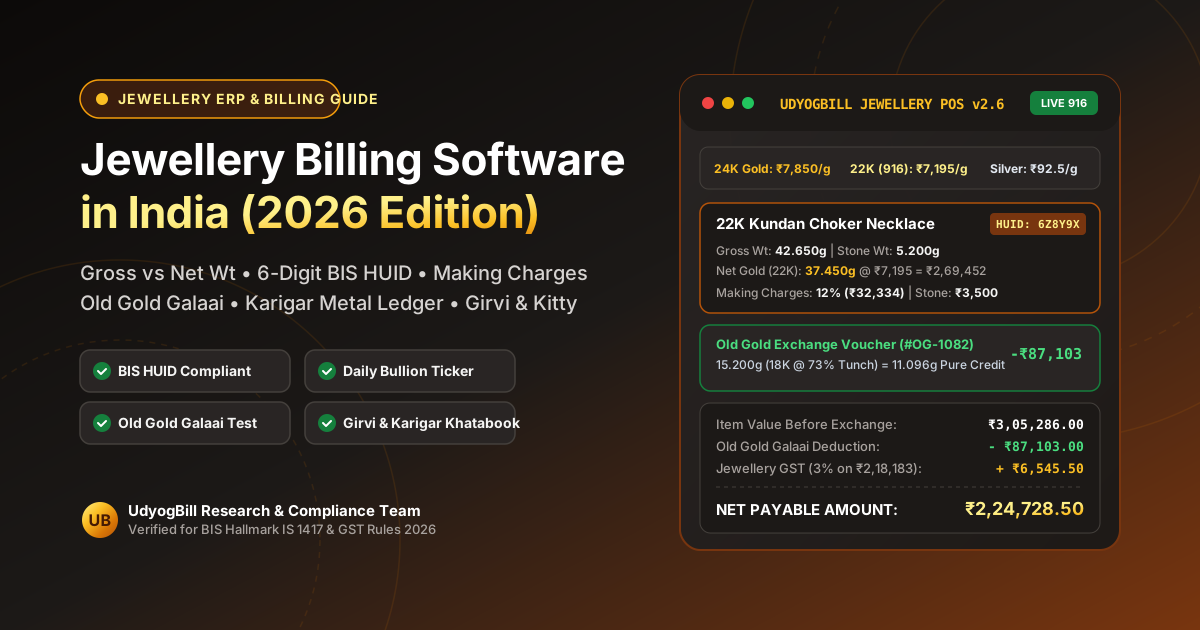
To understand how your billing software must calculate tickets under pressure, let us examine a real-world bridal transaction. A customer in your showroom selects a 22K Kundan Choker Necklace with semi-precious stone embellishments and exchanges an old family gold bangle.
Step-by-Step Calculation Breakdown:
- Gross Weight Measurement: The ornament is placed on the connected digital scale. Gross Weight =
42.650 grams. - Stone & Kundan Deduction: The tag records
5.200 gramsof stone/bead weight. Net Gold Weight =42.650g - 5.200g = 37.450 grams. - Metal Rate Multiplier: Today’s 22K 916 gold board rate is
₹7,195 per gram. Pure Metal Value =37.450g × ₹7,195 = ₹2,69,452.75. - Stone Value Addition: Studded semi-precious stones are billed at flat
₹3,500.00. - Making Charges (Ghadai): The showroom charges
12%making charges on net gold value. Making Charges =12% of ₹2,69,452.75 = ₹32,334.33. - Gross Item Value (Before Exchange):
₹2,69,452.75 + ₹3,500.00 + ₹32,334.33 = ₹3,05,287.08. - Old Gold Exchange Deduction: The customer exchanges an old 18K bangle weighing
15.200 grams. After fire melting (Galaai) and computerized XRF spectrometer testing, purity is tested at73.0% Tunch.
Pure 24K Gold Credit = 15.200g × 73.0% = 11.096 grams.
Old Gold Purchase Rate (24K Bullion Rate less ₹100 melting margin) =₹7,850/gram.
Old Gold Credit Value =11.096g × ₹7,850 = ₹87,103.60. - Taxable Base Calculation: Under Indian GST regulations, GST of 3% applies to the gross supply value before or after exchange depending on whether the purchase is booked as reverse-charge or immediate trade adjustment. When billed as composite ornament supply:
Taxable Value =₹3,05,287.08.
GST @ 3% (1.5% CGST + 1.5% SGST):₹9,158.61. - Net Payable by Customer:
(₹3,05,287.08 + ₹9,158.61) - ₹87,103.60 = ₹2,27,342.09.
| Parameter | Physical Value | Financial Value (₹) | Compliance / Billing Rule |
|---|---|---|---|
| Gross Weight | 42.650 g | — | Captured live from digital weighing balance |
| Stone / Nag Weight | - 5.200 g | ₹3,500.00 | Must be deducted prior to gold calculation |
| Net 22K Gold Weight | 37.450 g | ₹2,69,452.75 | Calculated at live 22K board rate (₹7,195/g) |
| Making Charges (12%) | — | ₹32,334.33 | Dynamic % on net gold metal amount |
| BIS HUID Hallmarking | 6Z8Y9X | Included | Mandatory 6-character laser code printed on bill |
| GST @ 3% (CGST 1.5% + SGST 1.5%) | — | + ₹9,158.61 | HSN 7113 composite rate for gold ornaments |
| Old Gold Exchange Credit | 11.096 g (Pure) | - ₹87,103.60 | Voucher #OG-1082 linked directly to ticket |
| FINAL PAYABLE AMOUNT | Net Wt 37.450g | ₹2,27,342.00 | Income Tax PAN mandatory (Bill > ₹2,00,000) |
Notice what happens at the end of this bill: because the total invoice value exceeds ₹2,00,000, the Indian Income Tax Act under Rule 114B mandates that the jeweller must collect and record the customer's verified PAN card number or Form 60. If your software does not automatically lock the bill until a valid 10-digit PAN is provided, your showroom faces severe penalties during tax assessment scrutiny.
3. BIS 6-Digit Alphanumeric HUID Laser Compliance (Mandatory Law)
Since April 1, 2023, the Bureau of Indian Standards (BIS) made Hallmark Unique Identification (HUID) mandatory across all hallmarked gold jewelry and artefacts sold in notified districts across India (under IS 1417:2019 guidelines). A traditional 4-mark hallmark is no longer legally sufficient.
Every piece in your showroom must be stamped with a unique 6-digit alphanumeric code (such as AB1234 or 6Z8Y9X) laser-engraved at a BIS Assaying and Hallmarking Centre (AHC). The legal implications for your billing process are non-negotiable:
- Invoice Print Requirement: The customer invoice must explicitly display the 6-digit HUID code alongside the karatage purity (24K 999, 22K 916, 18K 750, or 14K 585) for every individual line item.
- Barcode & RFID Tag Linkage: At the time of stock intake, your barcode printing software must generate jewellery dumbbell rat-tail tags that pair the item barcode directly with the BIS HUID code.
- Audit Defense: In the event of a BIS consumer quality grievance or assay testing verification, your software must be able to trace when the item was tagged, which Karigar manufactured it, which hallmarking centre stamped it, and which customer invoice it was sold on.
⚠️ Severe Compliance Warning
Selling hallmarked jewellery without printing the valid 6-digit HUID on the tax invoice constitutes an offence under Section 29 of the BIS Act, 2016, punishable by imprisonment of up to one year, or a fine of not less than ₹1,00,000 up to five times the value of the goods sold.
4. Old Gold Galaai (गलाई), Tunch (टंच) & Exchange Accounting
In Indian culture, over 40% of gold purchases involve trading in old ancestral jewellery. For a showroom owner, this is where massive operational confusion and metal leakage occur.
When an aunt brings in a pair of 20-year-old bangles, they are filled with wax (Lakh), copper solder joints, and dirt. If your sales staff guesses the purity or records the deduction on a scrap slip of paper, your business is hemorrhaging capital.
How UdyogBill Automates the Old Gold Exchange Voucher:
- Gross Weight & Stone/Lakh Cut: Enter gross weight (e.g., 20.000g) and subtract physical dirt/lac cut (e.g., 1.500g). Net scrap weight =
18.500g. - Tunch & Melting Deduction (Karda): Enter tested purity from your in-house XRF machine or local melter (e.g.,
74.5% purity) and allowed melting loss (e.g.,1.0% Galaai Karda). Effective purity =73.5%. - Pure Metal Conversion: The software calculates the fine 24K equivalent gold:
18.500g × 73.5% = 13.597 grams of 24K pure gold. - Instant Invoice Credit: The resulting rupee credit is adjusted directly as a tender mode against the new purchase ticket. The scrap gold is automatically received into your Scrap / Melting Vault Account in inventory.

5. Karigar Metal & Labour Ledgers: Stopping the 50-Gram Monthly Leak
Ask any veteran jeweller in Meerut, Rajkot, or Bowbazar where their biggest headache lies, and the answer is always the same: The Karigar Khata (कारीगर हिसाब किताब).
Unlike conventional suppliers who sell finished goods at a fixed rupee cost, goldsmith artisans receive raw 24K bullion bars or 22K alloyed grain from you. They handcraft the jewellery and return finished pieces days later, along with a certain amount of scrap dust and an unavoidable manufacturing metal loss known as Ghat (घात / क्षय).
Without dedicated dual-currency accounting, jewellers lose anywhere from 20 to 100 grams of pure gold every month in unaccounted shortages (Kasar / कसर). UdyogBill's Karigar Suite maintains two separate ledgers for every artisan:
⚖️ 1. Pure Metal Balance Ledger (Grams)
Maintained strictly in Fine 24K Grams down to 3 decimal places.
- • Gold Issued (देना): 200.000g of 24K fine bullion bar.
- • Finished Received (पाना): 195.400g of 22K ornaments (converted to fine equivalent:
179.186g) +17.200gscrap returned. - • Contractual Ghat Allowed:
1.5%maximum agreed loss. - • Shortage Alert (Kasar): If metal shortage exceeds agreed Ghat, the Karigar’s metal account is automatically debited.
💵 2. Labour Charges Ledger (Rupees)
Maintained in Indian Rupee currency for artisan manufacturing wages.
- • Labour Rates: Billed per gram (e.g., ₹380/g on casting) or per piece on handcrafted filigree.
- • Advance Wage Payments: Record cash or UPI advances paid to karigars during festive rush.
- • TDS & Jobwork GST (5%): Automatic calculation of Section 194C TDS and GST on jobwork under HSN 9988.
