
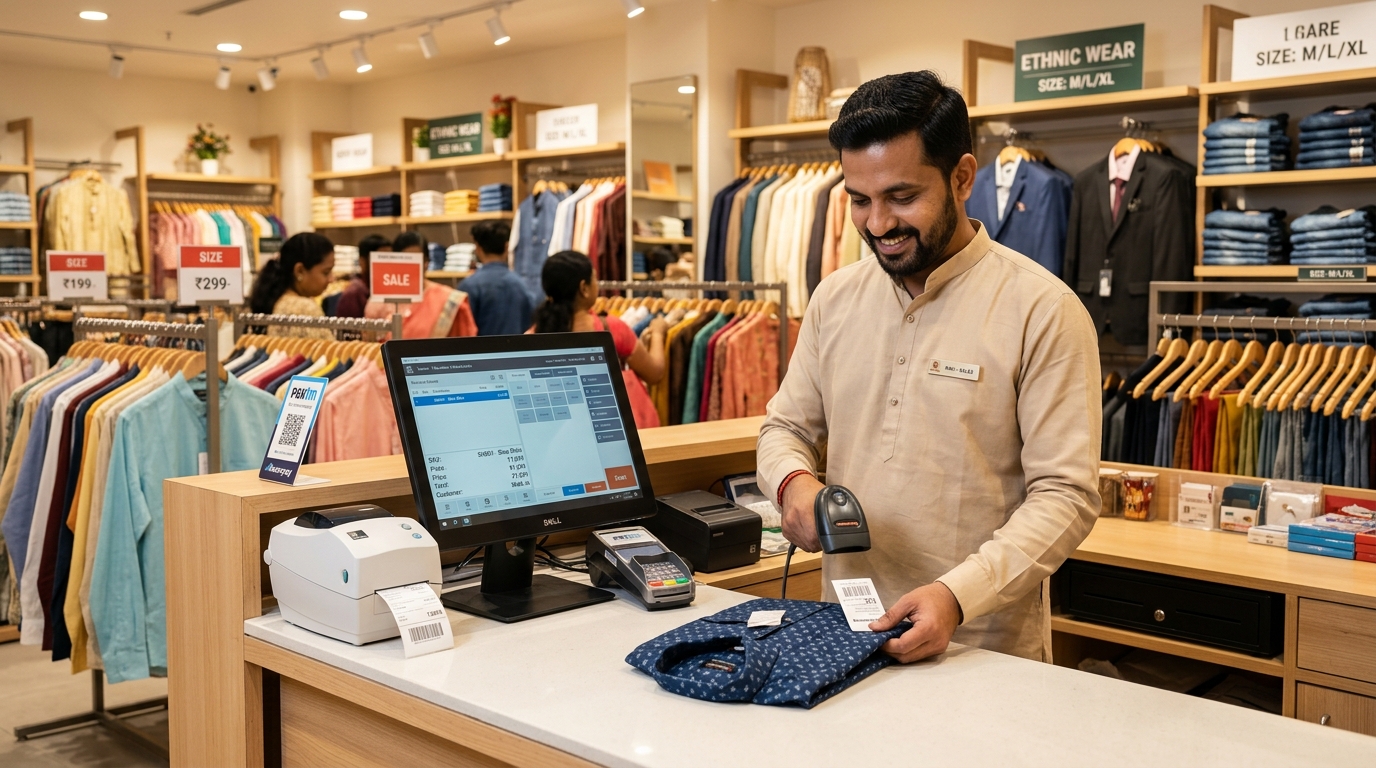
Garment shop billing software is a specialized point-of-sale (POS) and inventory management system designed for apparel, footwear, and readymade clothing retailers. Unlike generic grocery or retail billing software, a dedicated garment billing solution natively manages multi-dimensional Size-Color-Fit matrix grids, prints customized thermal barcode swing tags and price stickers, dynamically applies the Indian apparel dual GST threshold (5% for MRP ≤ ₹1,000 and 12% for > ₹1,000), automates End-of-Season Sale (EOSS) promotional combos (e.g., Buy 2 Get 1 Free), and dispatches instant paperless WhatsApp digital invoices with transparent exchange policies.
Want to See Garment Size-Color Billing Live on Your Screen?
Skip reading and get a personalized 2-minute live demo of barcode sticker printing, matrix grid billing, and WhatsApp invoices tailored for your clothing store.
Table of Contents: Navigating This Master Guide
- 1. The Unique Operational Realities of Indian Garment Retail
- 2. The Multi-Variant Size-Color-Fit Matrix Grid Explained
- 3. Custom Barcode Swing-Tag & Thermal Sticker Printing
- 4. Indian Apparel GST Compliance: Master the ₹1,000 Threshold Rule
- 5. Automated End-of-Season Sales (EOSS), Combos & Festival Rush POS
- 6. Deadstock Prevention & Broken-Size Ratio Management
- 7. Paperless WhatsApp Billing, Customer Ledgers & Exchange Controls
- 8. Complete Hardware & Implementation Checklist for Cloth Stores
- 9. Frequently Asked Questions (FAQ) with Expert Answers
1. The Unique Operational Realities of Indian Garment Retail
Running a readymade garment store, boutique, or clothing showroom in India is fundamentally different from operating a grocery store, pharmacy, or electronics dealership. When an FMCG retailer stocks a soap or biscuit, every unit shares the identical EAN-13 barcode, identical purchase cost, and identical size.
In contrast, apparel retail deals with multi-dimensional catalog explosion. A single casual cotton shirt from a wholesale distributor arrives in:
- 5 Standard Sizes: Small (S), Medium (M), Large (L), Extra Large (XL), Double XL (XXL).
- 4 Color Options: White, Sky Blue, Navy Blue, and Pastel Olive.
- 2 Sleeve Fits: Half Sleeves and Full Sleeves.
A single shirt design instantly branches into 40 individual Stock Keeping Units (SKUs)! If you manage a modest collection of just 150 designs across jeans, formal trousers, ethnic kurtis, t-shirts, and sarees, your retail floor suddenly houses over 6,000 distinct SKU variants.
When shopkeepers attempt to force standard, single-item billing software into this environment, their billing counter collapses under slow searches, misplaced stock balances, cashier confusion, and lost customer goodwill. A dedicated garment retail POS and inventory solution is not an optional luxury—it is the vital backbone that keeps your store profitable and agile.
Wholesale Bundle Purchases vs. Retail Single-Piece Sales
Another major operational friction point in Indian textile markets (such as Surat, Ahmedabad, Gandhi Nagar in Delhi, or Tirupur) is the bundle or set purchase model. Wholesalers sell readymade garments in pre-packed sets (e.g., a "Ratio Box" of 6 shirts: 1-S, 2-M, 2-L, 1-XL).
However, your walk-in retail customers never buy a ratio set; they buy a single piece of their preferred size. Your billing software must bridge this gap seamlessly: receiving wholesale vendor invoices as sets or master bundles, yet automatically breaking them down into individual size-wise stock balances on the showroom rack.
2. The Multi-Variant Size-Color-Fit Matrix Grid Explained
The cornerstone of any modern clothing store software is the Matrix Grid Engine. Rather than creating 40 separate items named "Cotton Shirt White S", "Cotton Shirt White M", and "Cotton Shirt Blue L", the software maintains a unified Parent Item Master with dynamic variant attributes.
| Attribute | Parent Master Item | Child Variants Generated | Billing Counter Action |
|---|---|---|---|
| Men's Slim Fit Shirt | Style #SH-402 (Pure Cotton) | Sizes: 38, 40, 42, 44 • Colors: Blue, Black, White | Cashier clicks style #SH-402 → selects size & color in 1 pop-up grid. |
| Denim Jeans | Article #DNM-90 (Stretchable) | Waist Sizes: 28, 30, 32, 34, 36 • Fits: Slim, Regular | Single scan retrieves exact waist balance immediately. |
| Ladies Kurti | Design #KRT-105 (Rayon Print) | Sizes: M, L, XL, XXL • Shades: Maroon, Mustard, Teal | Instant visibility of which shade is in trial room vs warehouse. |
| Footwear / Shoes | Model #SNK-07 (Sport Mesh) | Sizes: UK 6, 7, 8, 9, 10 • Colors: Grey, Black/Red | Prevents opening multiple shoe boxes during peak evening footfall. |
Real-Time Stock Availability in 2 Seconds
Imagine a walk-in customer trying on a 32-waist denim jeans who asks your floor salesman: "Bhaiya, do you have this same wash in size 34?"
Without matrix software, the salesman runs to the back warehouse, rummages through stacks for 10 minutes, and either discovers it is out of stock (wasting customer time) or leaves the customer unattended.
With an integrated garment inventory POS system, any staff member taps the screen or scans the hanger tag from a mobile counter. In under 2 seconds, the screen displays:
- Size 32: 1 piece on display rack.
- Size 34: 3 pieces in Upper Stockroom (Rack B-4).
- Size 36: 0 pieces (Marked as Out of Stock, vendor re-order suggested).
The customer gets instant service, and your store never misses a conversion due to warehouse disorganization.
3. Custom Barcode Swing-Tag & Thermal Sticker Printing
Over 70% of readymade garments sold across Tier 1, Tier 2, and Tier 3 Indian retail markets arrive from wholesale hubs in polybags with no standardized barcodes. Relying on handwritten paper price tags or manual price lookup at the cash counter creates three lethal problems:
- Price Manipulation & Shoplifting: Customers or unscrupulous staff can easily switch paper tags or dispute prices.
- Slow Counter Queues: Cashiers must manually search each design, causing long waiting lines during festive rush hours.
- Inventory Drift: Staff accidentally ring up an expensive designer shirt as a basic shirt, destroying inventory accuracy.
What Belongs on a Professional Garment Swing Tag?
Modern thermal barcode printers (such as TVS LP 46 Neo, TSC TE244, Citizen, or Zebra) allow you to print high-density 1D/2D barcodes on both adhesive butterfly jewelry tags and heavy cardstock swing tags.
| Tag Data Element | Example Output | Why It Matters to the Customer & Store |
|---|---|---|
| Store Brand Name | ROYAL ATTIRE BOUTIQUE | Builds consumer trust and brand recall. |
| Item / Design Code | ART: JKT-2024-WOOL | Allows instant vendor identification on re-stocking. |
| Size & Fit | SIZE: 42 (XL) • SLIM FIT | Ensures customer picks the right fit without unfolding items. |
| Color / Shade | SHADE: CHARCOAL GREY | Prevents barcode swapping between different color grades. |
| Maximum Retail Price (MRP) | MRP: ₹1,899 (Incl. of all taxes) | Ensures legal legal metrology compliance. |
| Offer / Store Price | OUR PRICE: ₹1,299 | Highlights consumer savings and drives impulse purchases. |
| Scannable Barcode (Code-128) | ||| | || |||| | ||||||| 8901248002 | Sub-second checkout at the point-of-sale scanner. |
To learn how to connect hardware, calibrate tag rolls, and print batches directly from purchase invoices, explore our comprehensive technical guide on setting up barcode POS hardware for garment shops in India.
4. Indian Apparel GST Compliance: Master the ₹1,000 Threshold Rule
Under Indian Goods and Services Tax (GST) regulations, the textile, apparel, and footwear sectors operate under a unique value-based differential tax slab. Failing to calculate this accurately invites severe tax penalties or customer overcharges during GST return filing (GSTR-1 and GSTR-3B).
Under HSN Chapter 61 (Knitted Garments) and HSN Chapter 62 (Woven Garments):
• Apparel items where the sale value per piece is up to ₹1,000 are taxed at 5% GST (2.5% CGST + 2.5% SGST, or 5% IGST).
• Apparel items where the sale value per piece exceeds ₹1,000 are taxed at 12% GST (6% CGST + 6% SGST, or 12% IGST).
The "Discount Trap" That Confuses Manual Cashiers
Where most manual billing processes fail is during seasonal sales and counter discounts. The tax slab is determined by the actual transaction value (net realized price) per piece, NOT merely the printed MRP!
| Product Example | Printed MRP | Discount Given | Net Taxable Value | Applicable GST Rate | Total Final Bill |
|---|---|---|---|---|---|
| Formal Trouser | ₹1,400 | No Discount | ₹1,250 + Tax | 12% GST | ₹1,400.00 |
| Denim Jacket | ₹1,200 | 25% Festive Off (₹300) | ₹900.00 (≤ ₹1,000) | 5% GST (Rate drops automatically!) | ₹945.00 |
| Cotton T-Shirt | ₹699 | 10% Off (₹70) | ₹629.00 (≤ ₹1,000) | 5% GST | ₹660.45 |
If your cash counter software cannot dynamically adjust the tax rate when a discount pushes an item's value below the ₹1,000 threshold, you either overcharge your customer 12% instead of 5% (making your store seem expensive) or overpay tax to the government from your own margin!
For an in-depth chapter-by-chapter walkthrough of HSN code mapping, input tax credit (ITC) reconciliation, and reverse charge mechanisms, check our dedicated GST Billing Guide for Garment Shops.
Are You Factoring Deadstock Risks Into Your Wholesale Markups?
When you purchase a 6-piece wholesale bundle for ₹3,600, your base cost is ₹600/piece. But if 1 broken size remains unsold on your rack, your true cost per piece rises to ₹720! Use our free online calculator to determine the exact retail MRP needed to safeguard your target margins.
Open Garment Set Markup & Deadstock Calculator →